Integration Principles




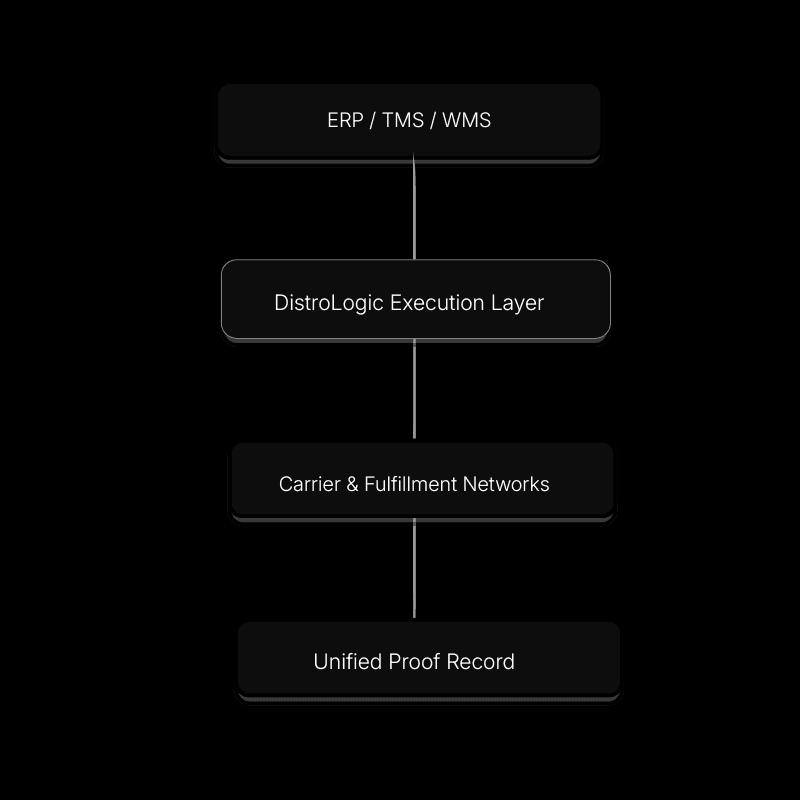
ERP, TMS, WMS, carrier, and fulfillment systems remain systems of record. DistroLogic governs execution across them.
Enterprise System Surfaces
DistroLogic integrates across the primary system surfaces that govern enterprise trade, logistics, and execution. The platform aligns to existing investments while normalizing signals across upstream planning systems and downstream execution networks.

Core Enterprise Systems
Integration with enterprise resource planning systems to ingest order intent, product master data, pricing structures, and financial controls.
Example Systems
SAP S/4HANA and SAP ECC
Oracle ERP Cloud and E-Business Suite
Microsoft Dynamics 365
Infor LN and M3
IFS Cloud
QAD Adaptive ERP

Integration & Middleware Frameworks
Interoperability with middleware, EDI networks, and integration frameworks to normalize enterprise data exchange and trading partner communication.
Example Systems
OpenText Trading Grid
IBM Sterling
SPS Commerce
MuleSoft
Boomi
Azure Logic Apps

Transportation Management Systems
Alignment with transportation planning and carrier management systems to coordinate routing, tendering, and shipment lifecycle execution.
Example Systems
SAP Transportation Management
Oracle Transportation Management
Blue Yonder
Manhattan Active TM
MercuryGate
Transporeon
Descartes

Trade & Compliance Systems
Alignment with trade intelligence, customs, and regulatory systems to ensure compliant execution across jurisdictions.
Example Systems
SAP GTS
Descartes
Amber Road
CargoWise
Integration Point

Warehouse & Execution Systems
Integration with warehouse management and fulfillment systems to preserve execution continuity and event synchronization across facilities.
Example Systems
SAP EWM
Manhattan Active WMS
Blue Yonder WMS
Körber
Infor WMS
Oracle WMS Cloud

Carrier & Event Networks
Event-level integration with parcel, freight, and multimodal carrier systems to preserve shipment continuity and traceability across physical networks.
Examples
FedEx
UPS
DHL
USPS
Maersk
MSC
CMA CGM
Integration Model
DistroLogic integrates through a governed, event-driven architecture designed to align with enterprise system boundaries. Rather than replacing existing platforms, the system normalizes inbound signals, applies execution policy, and returns synchronized execution data across integrated environments.
Signal Ingestion Layer
Policy & Orchestration Layer
Execution & Proof Synchronization Layer
Implementation Approach
Integration is performed through structured discovery, controlled mapping, and phased validation. Existing system ownership is preserved throughout implementation.
Most integrations are executed through adapter configuration rather than core system modification, reducing operational risk and deployment complexity.
Industry Networks & Standards Alignment
Automotive & Advanced Manufacturing Ecosystems
Alignment with automotive and industrial supply chain data exchange standards and collaborative manufacturing ecosystems.
Examples:
Catena-X interoperability model
AIAG data exchange standards
Odette supply chain frameworks
VDA logistics specifications
ISO 9001 / IATF 16949 contextual alignment
Aerospace & Regulated Logistics Frameworks
Designed to operate within compliance-sensitive and traceability-driven aerospace and defense supply chains.
Examples
ATA Spec 2000
IATA Cargo-XML
FAA traceability requirements
EASA documentation frameworks
ITAR contextual handling considerations
Global Trade & Customs Standards
Integration with global customs documentation standards, electronic trade frameworks, and jurisdictional compliance protocols.
Examples
WCO data model
UN/EDIFACT
Harmonized System (HS) classification
DDP and landed cost modeling standards
Electronic customs filing interfaces
DistroLogic operates within established industry interoperability models while preserving enterprise system sovereignty and network independence.
Data Sovereignty & Network Governance
System-of-Record Preservation
ERP, TMS, WMS, and partner systems remain systems of record. DistroLogic governs execution state without redefining enterprise ownership boundaries.
Federated Data Model
Execution data is normalized for governance and traceability while respecting enterprise data residency, jurisdictional constraints, and partner-specific data policies.
Network Neutrality
The platform operates across carrier, 3PL, and industry networks without establishing exclusive control or proprietary lock-in structures.
Audit-First Architecture
All cross-system interactions are structured to produce verifiable records aligned with enterprise audit, reconciliation, and compliance standards.
DistroLogic governs execution across enterprise systems and global networks while preserving ecosystem integrity, operational autonomy, and regulatory alignment.